European Spring by Philippe Legrain
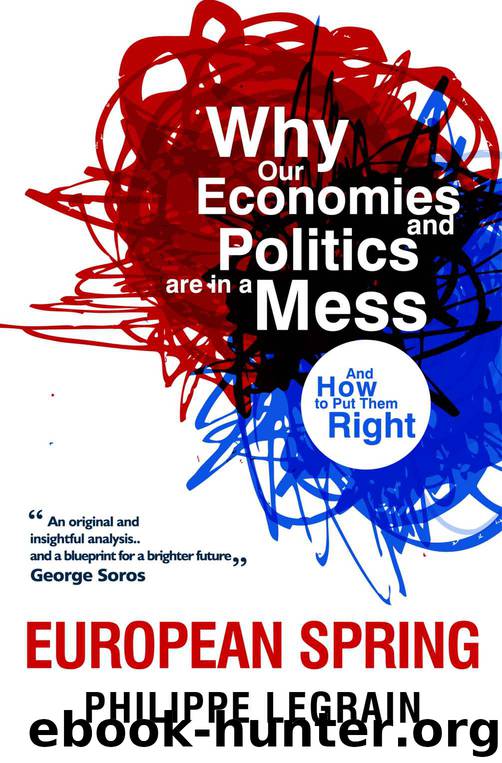
Author:Philippe Legrain
Language: eng
Format: mobi
Publisher: CB Creative Books
Published: 2014-04-24T00:00:00+00:00
10. ADAPT!
How to cope with and adjust to change
We have involved ourselves in a colossal muddle, having blundered in the control of a delicate machine, the working of which we do not understand.
John Maynard Keynes, The Great Slump of 1930, 1930542
The curious task of economics is to demonstrate to men how little they really know about what they imagine they can design.
Friedrich von Hayek, The Fatal Conceit, 1988543
Change happens all the time. Some of it is reasonably predictable: higher demand for ice cream in summer. Some of it isn’t: out of nowhere, Gangnam Style became a global hit. Big changes often happen unexpectedly. The Berlin Wall falls. The Fukushima earthquake knocks out a big chunk of the Japanese economy and with it crucial links in global supply chains. Hydraulic fracturing (“fracking”) leads to a shale-gas boom that transforms America’s energy landscape – and Europe’s – within a few years. Apple was left for dead at the turn of the century, then vaulted to being the world’s most valuable listed company. American house prices never fell – and then they did. The Western financial system collapses. When such unexpected changes happen, it is often hard to know whether they will last. Harry Potter did, Gangnam Style didn’t. The rise of East Asia seemed inexorable; then out of the blue the 1997–98 crisis happened and it was widely written off; then it bounced back. The Arab Spring took everyone by surprise, then seemed like one-way traffic – until Egypt had its counterrevolution. Other changes are more predictably enduring, such as the ageing of European societies. Still others are probable but shrouded in uncertainty, not least climate change.
If you believe that economic systems, like all forms of social interaction, are complex and always in flux, often in unpredictable and non-linear ways – or if you simply observe that changes and “shocks” are all too frequent – adaptability is a key feature of any successful economy. An adaptable system can cope with a variety of circumstances – boom and bust, both high and low oil prices, the emergence of new technologies, the rapid development of other economies, a financial crash – and adjust where necessary. In contrast, a fragile system may collapse when confronted with change, while a rigid one will struggle to adjust. This chapter will first look at how to make the economy less fragile, notably in the face of financial upheaval. Then it will examine how to make economies more flexible. Lastly, it will suggest how to adjust to reasonably predictable changes, such as demographic trends, and hugely uncertain ones, such as climate change. Change often comes out of the blue, so this chapter cannot, and does not aim to, cover every conceivable one.
Less fragile finance
Europe’s biggest source of fragility is its over-reliance on debt. Banks and other financial players, companies and households all finance an excessive share of their investments with debt. For individual borrowers, this magnifies the upside but leaves them perilously exposed if asset prices fall. Relying on
Download
This site does not store any files on its server. We only index and link to content provided by other sites. Please contact the content providers to delete copyright contents if any and email us, we'll remove relevant links or contents immediately.
| Anthropology | Archaeology |
| Philosophy | Politics & Government |
| Social Sciences | Sociology |
| Women's Studies |
The Secret History by Donna Tartt(18983)
The Social Justice Warrior Handbook by Lisa De Pasquale(12174)
Thirteen Reasons Why by Jay Asher(8863)
This Is How You Lose Her by Junot Diaz(6852)
Weapons of Math Destruction by Cathy O'Neil(6240)
Zero to One by Peter Thiel(5751)
Beartown by Fredrik Backman(5698)
The Myth of the Strong Leader by Archie Brown(5479)
The Fire Next Time by James Baldwin(5404)
How Democracies Die by Steven Levitsky & Daniel Ziblatt(5189)
Promise Me, Dad by Joe Biden(5125)
Stone's Rules by Roger Stone(5062)
A Higher Loyalty: Truth, Lies, and Leadership by James Comey(4933)
100 Deadly Skills by Clint Emerson(4896)
Rise and Kill First by Ronen Bergman(4751)
Secrecy World by Jake Bernstein(4718)
The David Icke Guide to the Global Conspiracy (and how to end it) by David Icke(4668)
The Farm by Tom Rob Smith(4481)
The Doomsday Machine by Daniel Ellsberg(4465)
